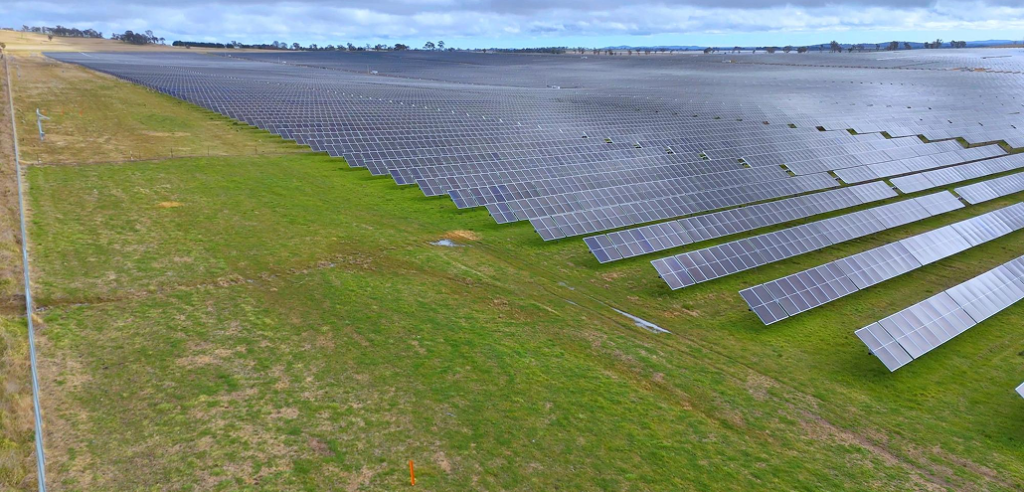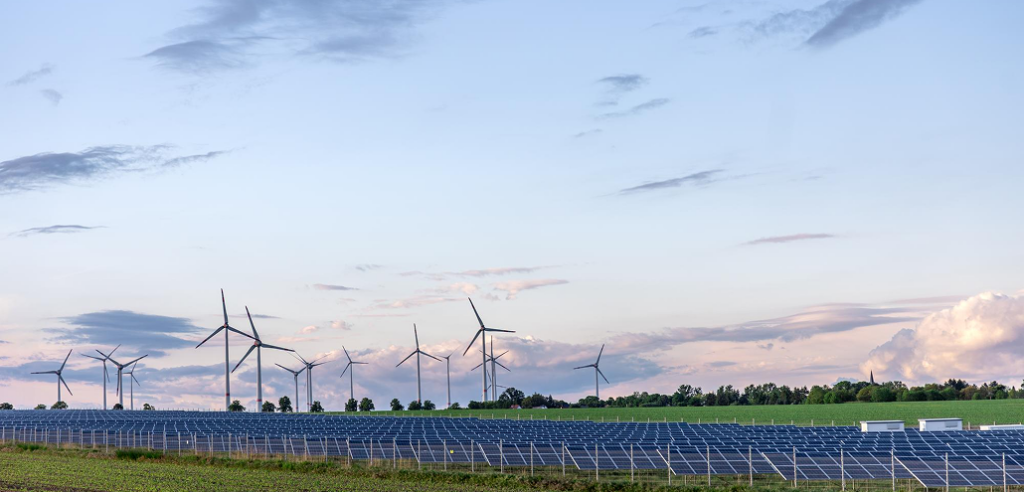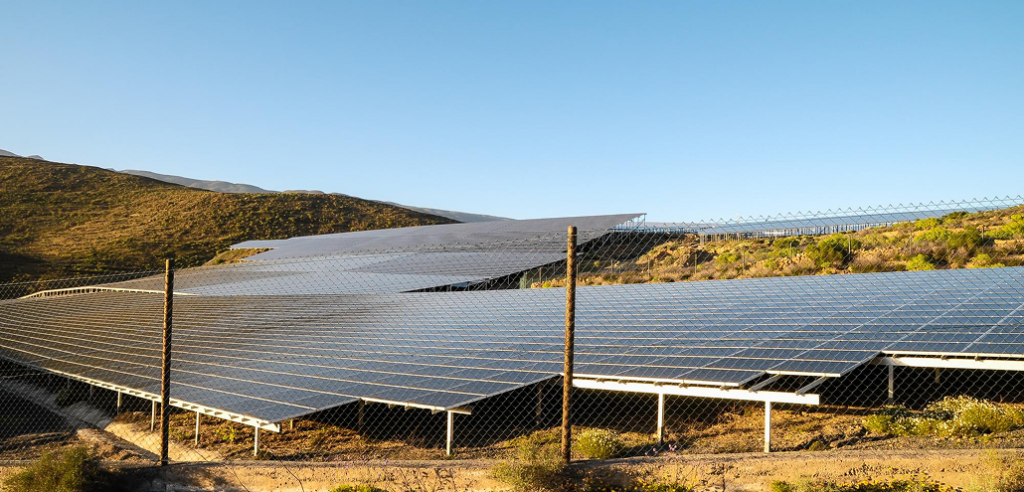
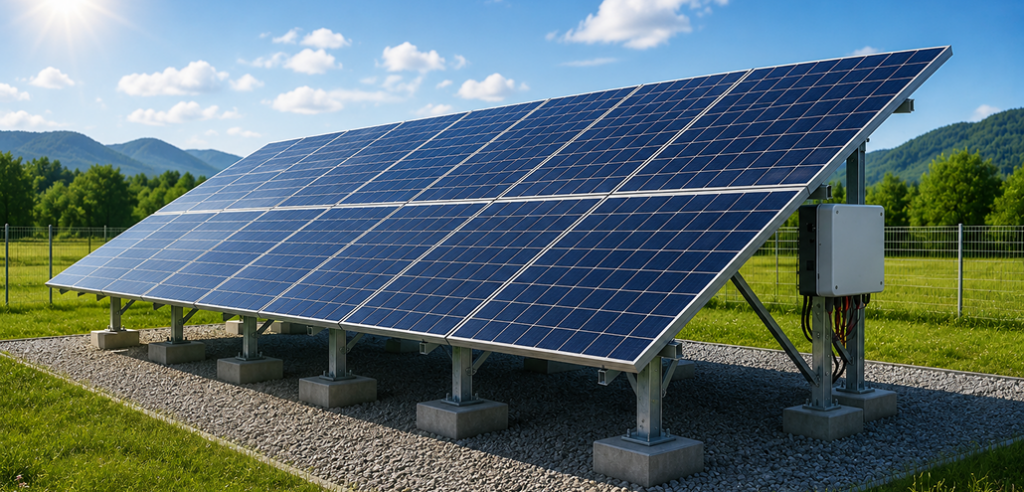
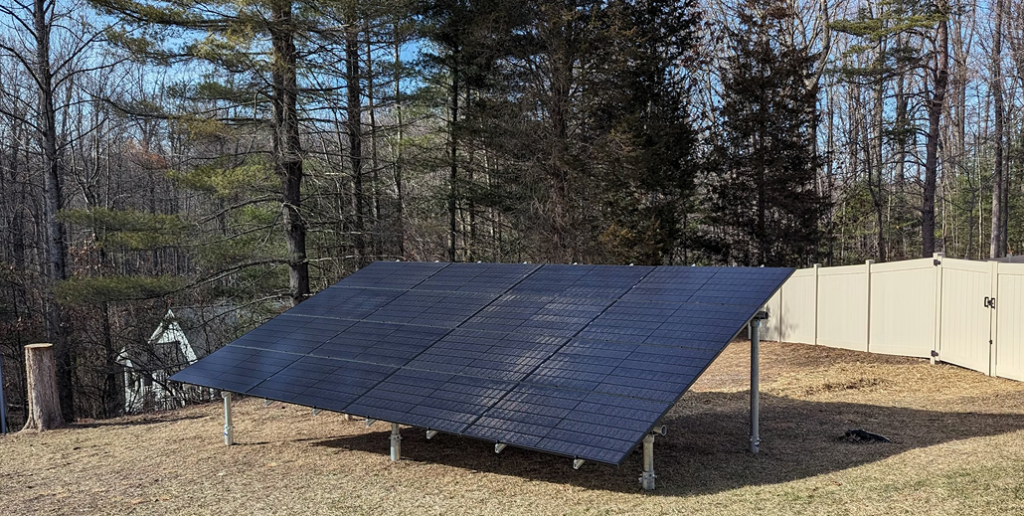
Ground mounted solar panels are exactly what they sound like: photovoltaic panels installed on a free-standing structure on the ground rather than attached to a roof. They’re the answer for properties where the roof isn’t suitable, where there’s land available, or where the project is too big to fit on a building.
For Australian properties with the right conditions, ground mount systems often outperform rooftop systems. Panels can be tilted to the optimum angle for the latitude, oriented true north regardless of building shape, and serviced from the ground without anyone climbing onto a roof. The trade-off is a higher upfront cost because you’re paying for the structure as well as the solar hardware.
This guide covers what ground mount systems are, when they make sense, the main configurations available in Australia, and what installers and property owners need to weigh up before committing to one.
Key takeaway
- Ground mounted solar panels sit on a free-standing structure on the ground, ideal for properties with available land or unsuitable roofs.
- They typically deliver higher energy yield than rooftop systems because tilt and orientation can be optimised for the site.
- Two main foundation types: ballasted (concrete footings) and ground screws. Soil conditions and project scale dictate which one fits.
- Fixed-tilt systems suit residential and commercial Australian sites; tracking systems are usually reserved for large utility-scale projects.
- The biggest considerations are land area, soil type, wind region, and budget. Ground mount systems cost more upfront than rooftop, but generate more energy per panel.
What is a ground mounted solar panel system?
A ground mounted solar panel system is a free-standing array installed on the ground using a structural mounting frame, foundations, and a tilted rail system that holds the panels at an optimised angle. The whole assembly sits on its own structure rather than relying on an existing building.
The basic components are consistent across most designs:
- Foundations: concrete ballast footings or ground screws, depending on soil and project size
- Upright supports: vertical posts that carry the load and set the height of the array
- Rear brace supports: angled struts that anchor the structure against wind loads
- Rails: horizontal members the panels clamp onto
- Module clamps: the fasteners that secure each panel to the rails
A residential ground mount system might cover 20–40 square metres and produce 5–10 kW. A commercial array can cover several hectares and reach megawatt scale. The engineering principles are the same; only the size and complexity change.
Why ground mount systems often outperform rooftop solar
The main reason ground mount systems exist is that they remove the constraints a roof imposes. Rooftop installs are limited by the roof’s pitch, orientation, structural capacity, shading from chimneys or vents, and the need to leave fire-safety access pathways under Clean Energy Council guidelines. A ground mount has none of those constraints.
That translates into three real-world advantages:
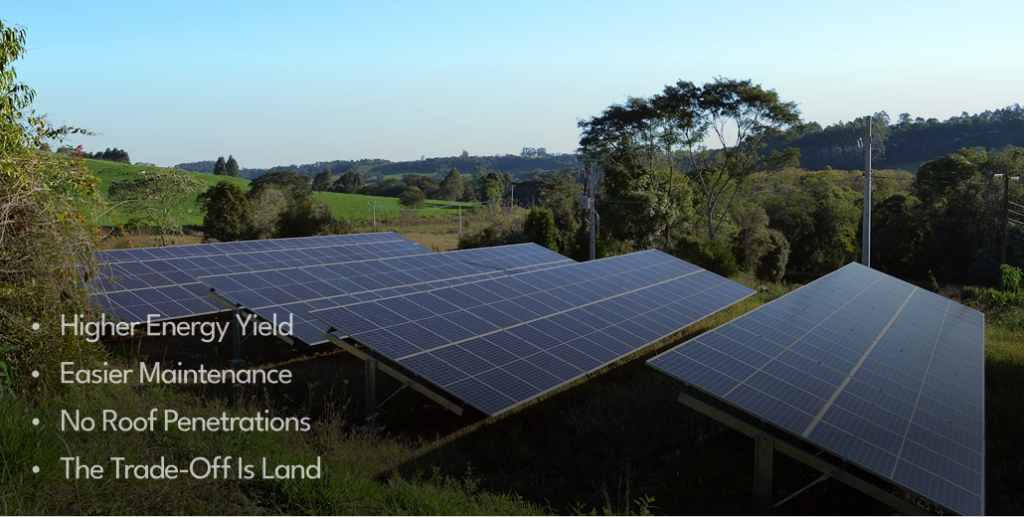
Higher energy yield. Panels can be tilted to the optimum angle for the latitude, typically 25–35° for most of Australia, and oriented true north for maximum sun exposure. A north-facing ground mount at the right tilt can produce 10–15% more energy per panel than the same panels on a poorly oriented roof, based on standard solar irradiance modelling for Australian latitudes.
Easier maintenance. Cleaning, inspection, and panel replacement happen at ground level. Over a 25-year system life, the maintenance cost difference adds up.
No roof penetrations. The roof stays untouched. For property owners worried about leaks, voiding tile or membrane warranties, or working with a roof that’s near end-of-life, that’s a meaningful advantage.
The trade-off is land. Ground mount systems need clear, level (or near-level), unshaded ground that won’t be needed for anything else for the next 25 years. For most suburban properties that’s a barrier. For rural, semi-rural, and commercial sites with parking, paddocks, or unused land, it isn’t.
When ground mount solar panels are the right choice
There are five common scenarios where ground mount is the better option than rooftop or carport solar.
The roof can’t take a solar array
Some roofs aren’t suitable for solar. Old tile roofs nearing replacement, asbestos roofs, structurally weak roofs, heritage-listed properties, and roofs with too much shading from trees or other buildings are all reasons to look at ground mount instead.
The property has available land
Rural properties, farms, semi-rural blocks, and large commercial sites often have significantly more usable ground area than roof area. A 100 kW commercial system might need 600–800 square metres of ground area, roughly twice the available rooftop on most light-industrial buildings.
The project is too big for a roof
Once a project exceeds roughly 100 kW, fitting it on a roof becomes difficult. Commercial and utility-scale projects from 250 kW into the megawatt range are almost always solar power ground mounted because no commercial roof can accommodate them.
The owner wants maximum energy yield
For energy-intensive properties (farms running irrigation, agribusinesses with refrigeration loads, manufacturing sites), the production gain from optimal orientation and tilt makes the higher upfront cost pay back faster.
The site is in a high-wind or cyclonic zone
This one’s counter-intuitive. Ground mount systems built to AS/NZS 1170.2 cyclonic specifications can be more resilient than rooftop arrays in high-wind zones because the engineer designs the structure from the ground up for the load. We’ll cover this in more detail in our forthcoming guide on ground mount solar system failures in high-wind zones.
The two foundation types: ballasted vs ground screws
Foundation choice is the single most important decision after picking the right system. It dictates install time, cost, and what kinds of soil the project can work in.
Ballasted (concrete footing) foundations
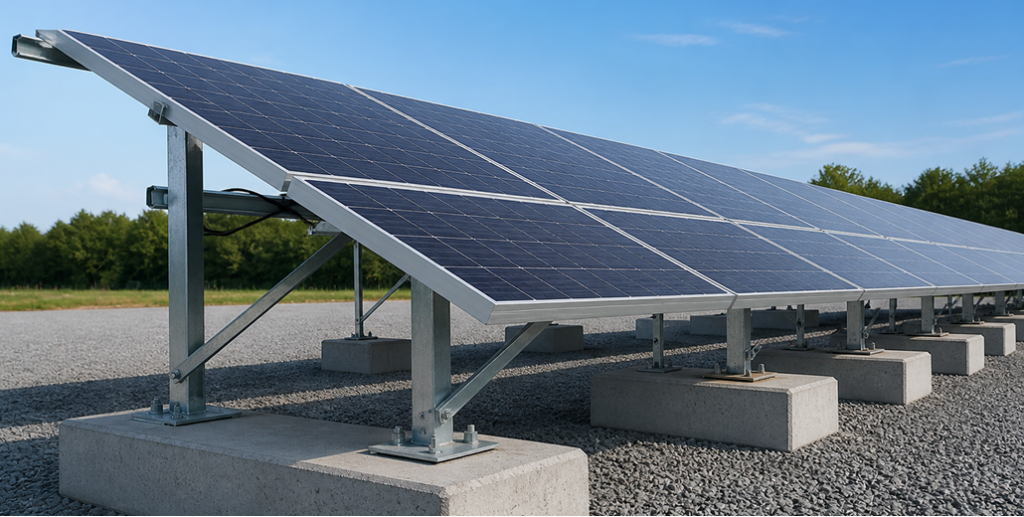
Ballasted systems use poured concrete footings that sit either on or just below ground level. The structure bolts into the concrete. They’re the traditional approach and work in almost any soil type because the load is spread across a large footprint.
Best for: rocky ground, sites with shallow bedrock, mixed or unknown soil conditions, very large arrays where economies of scale make concrete viable.
Trade-offs: longer install time, more excavation, higher labour cost, and a permanent footprint that’s expensive to remove.
Ground screw foundations
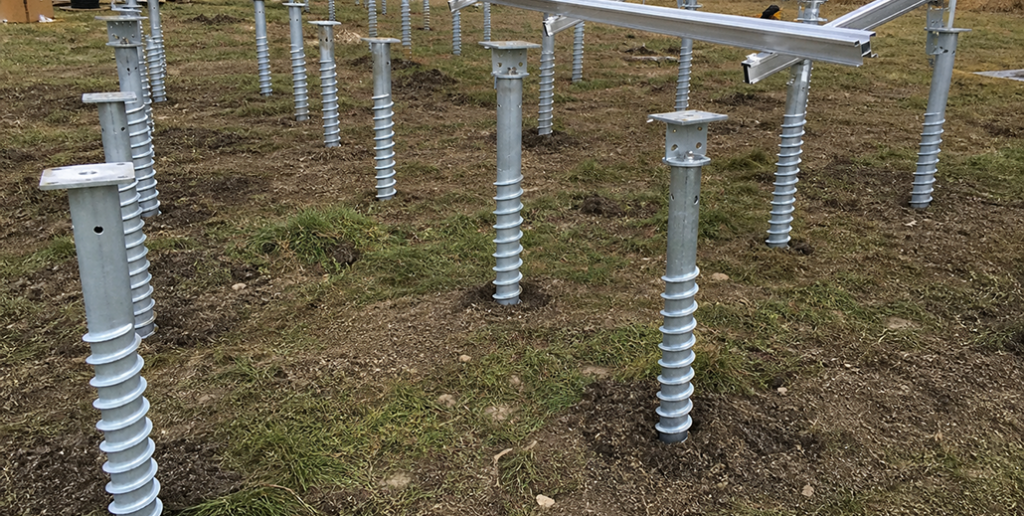
Ground screws are large helical steel anchors driven directly into the soil. They eliminate concrete entirely.
Best for: stable soils (clay, compacted earth, sandy loam), commercial-scale projects where install speed matters, sites where minimal ground disturbance is preferred (agricultural land, environmentally sensitive areas).
Trade-offs: unsuitable for rocky ground or very loose soil, requires a soil report before quoting, specialised installation equipment.
The Nova Ground Mount System supports both foundation types as standard. For installers, that flexibility means one system can quote across a wider range of sites without changing suppliers.
Nova’s field notes: never quote a ground screw foundation without a soil report
In our experience working with installers across Australia, the single most common reason a ground mount project goes sideways is a soil surprise. A site that looked perfect on a satellite image turns out to have shallow bedrock, or a rocky layer 600 mm down, or unexpectedly high water table. Suddenly ground screws aren’t viable and the project needs a different foundation system.
Get the soil report before you finalise the quote. On commercial projects, build the cost of the geotech survey into the proposal as a line item if needed. It’s the cheapest insurance you can buy on a ground mount project.
Fixed tilt vs tracking systems
The second big choice is whether the array is fixed in place or moves to follow the sun. For 95% of Australian projects, fixed tilt is the right answer. Here’s why.
| Feature | Fixed tilt | Single-axis tracking | Dual-axis tracking |
| Energy yield uplift | Baseline | +15–25% | +25–35% |
| Upfront cost vs fixed | Baseline | +25–40% | +50–80% |
| Moving parts | None | Motor, drive system, controllers | Motor, drive system, controllers (more axes) |
| Maintenance burden | Minimal | Annual service, motor replacements | Significant ongoing maintenance |
| Best suited to | Residential and commercial | Utility-scale (multi-MW) | Specialised research and high-value sites |
Fixed tilt systems are set at one angle (usually 25–35° in Australia) and stay there. They’re simpler, cheaper, more reliable, and account for the vast majority of Australian ground mount installs. The Nova Ground Mount System supports adjustable tilt from 5° to 60°, which is unusually wide and lets installers optimise for any Australian latitude.
Tracking systems rotate panels through the day to follow the sun. The yield uplift sounds attractive, but the maths usually doesn’t work outside large utility-scale projects. The added cost, the maintenance burden, and the failure points (motors, controllers, gearboxes) typically push payback well beyond what fixed tilt delivers. For commercial and residential projects, the extra capital is almost always better spent on more fixed-tilt panels.
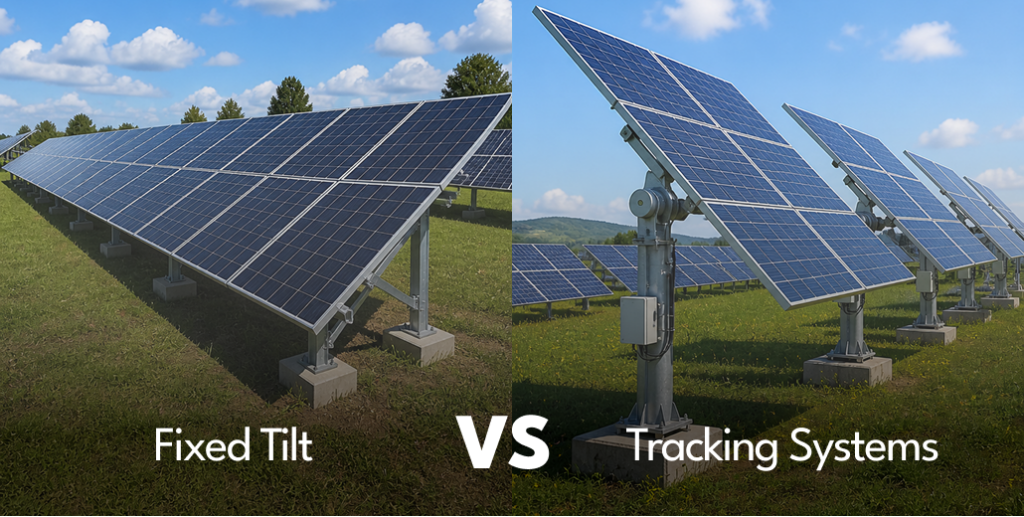
For a deeper comparison covering when each is worth the investment, see our guide to ground mount solar tracking systems versus fixed tilt.
Nova doesn’t manufacture tracking systems. Our Ground Mount System is a fixed-tilt design because that’s what makes financial sense for the projects our customers actually quote.
Key considerations for Australian sites
Five factors decide whether a ground mount system will perform over its 25-year life or become a maintenance headache.
1. Available land area
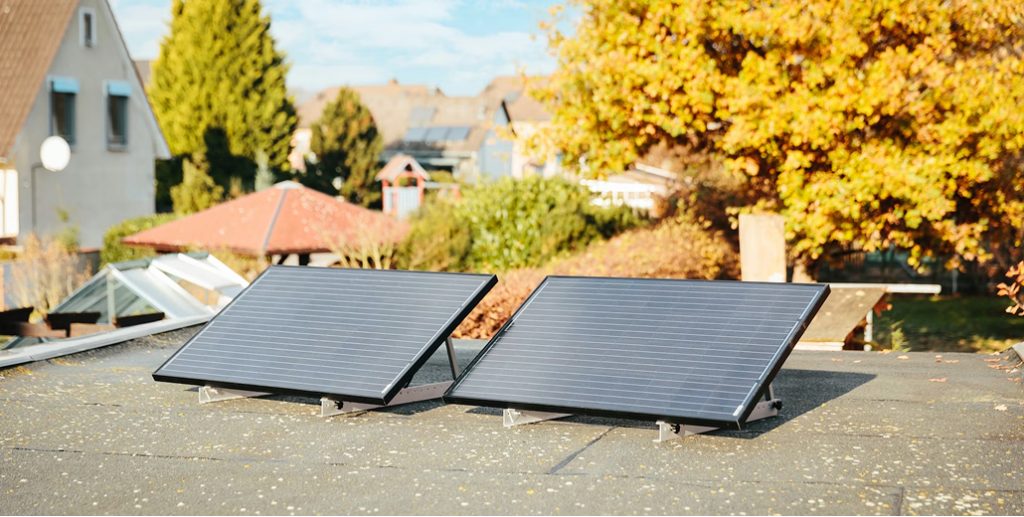
A rough rule of thumb: residential 5–10 kW systems need 30–60 square metres; commercial 100 kW systems need 600–800 square metres; megawatt-scale projects need a hectare or more. The land also needs to be unshaded, accessible for installation, and clear of underground services.
2. Soil and ground conditions
A geotechnical report is essential for anything beyond a small residential install. The report will identify soil type, bearing capacity, water table depth, and any obstacles like bedrock or buried services. Soil determines foundation choice; soil also determines whether ground screws are even an option.
3. Wind region
Australia is divided into wind regions A through D under AS/NZS 1170.2. Region A covers most metro areas; Region B covers eastern and southern coastal strips; Region C covers tropical northern coasts; Region D covers severe cyclonic zones in northern Australia. The structural design and the cost both scale up significantly as you move from A to D.
4. Material durability
Standard galvanised steel works in dry inland conditions but corrodes faster in humid, coastal, or tropical environments. Zinc Aluminium Magnesium (ZAM) coated steel offers significantly better corrosion resistance than traditional hot-dip galvanising and is now the preferred choice for most Australian ground mount projects, especially within reach of coastal salt or in tropical zones.
5. Compliance and approvals
Every Australian solar install needs to comply with AS/NZS 5033 for PV array installation, AS/NZS 1170.2 for structural design, and CEC guidelines for STC eligibility. Ground mount systems also typically need council approval, which varies widely between local government areas. Always check before quoting.
Nova’s field notes: cyclonic zone projects need a different conversation from day one
The wind loading calculations under AS/NZS 1170.2 produce structural requirements that change foundation depth, beam sizing, brace specification, and clamp torque requirements. Trying to retrofit a Region A quote for a Region C site is one of the fastest ways to burn margin on a ground mount project.
If the project is in Region C or D, get the structural engineer involved before the quote, not after. Build the engineering fee into the proposal. And be honest about what cyclonic-rated hardware costs, the gap between Region A and Region D pricing on the same nominal system size can be 30% or more.
Ground mount vs rooftop vs carport: which is right for the project?
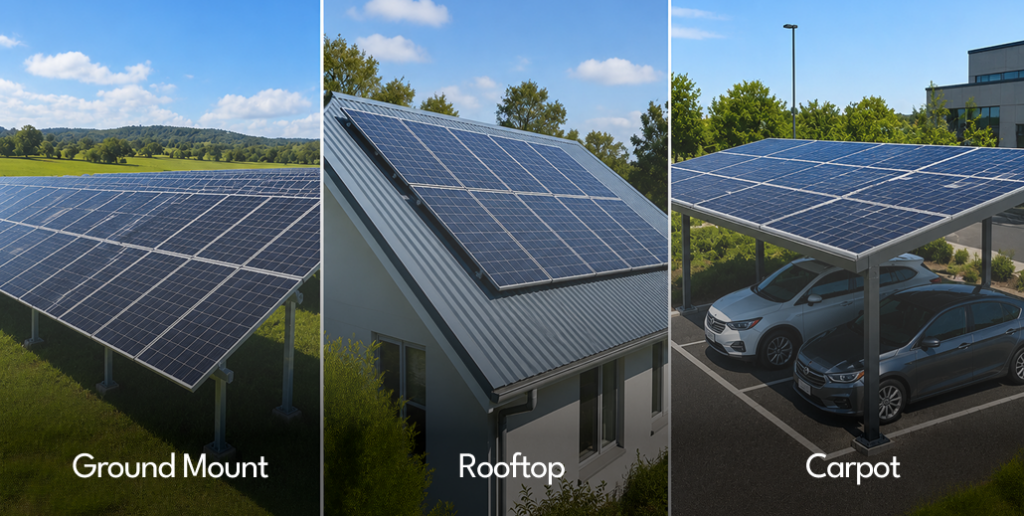
For most Australian properties, the choice between mounting types comes down to available space, budget, and goals.
| Mounting type | Best when | Watch out for |
| Rooftop | Roof is suitable, space is limited, lowest upfront cost matters | Roof orientation and pitch limits performance; harder to maintain |
| Carport | Parking area is available, vehicle protection is valued, dual-use space matters | Higher cost per watt than ground mount; structural complexity |
| Ground mount | Land is available, maximum energy yield matters, project is large | Land use commitment for 25+ years; geotech and council approvals required |
For a project with both available land and parking, the decision often comes down to whether the customer values vehicle protection (carport) or pure energy yield (ground mount).
How ground mount system installation works
Ground mount installation is more involved than rooftop because the structure has to be built from scratch. The typical sequence runs:
- Site assessment and soil report. Confirms soil type, bearing capacity, and access.
- Design and structural engineering. Sizing, tilt, layout, and AS/NZS 1170.2 compliance.
- Council approval and permits. Where required.
- Foundation installation. Concrete pours and curing, or ground screw installation.
- Structure assembly. Upright supports, rear braces, rails.
- Panel mounting. Modules clamped to rails.
- Electrical work. DC wiring, inverter installation, grid connection.
- Commissioning and CEC sign-off.
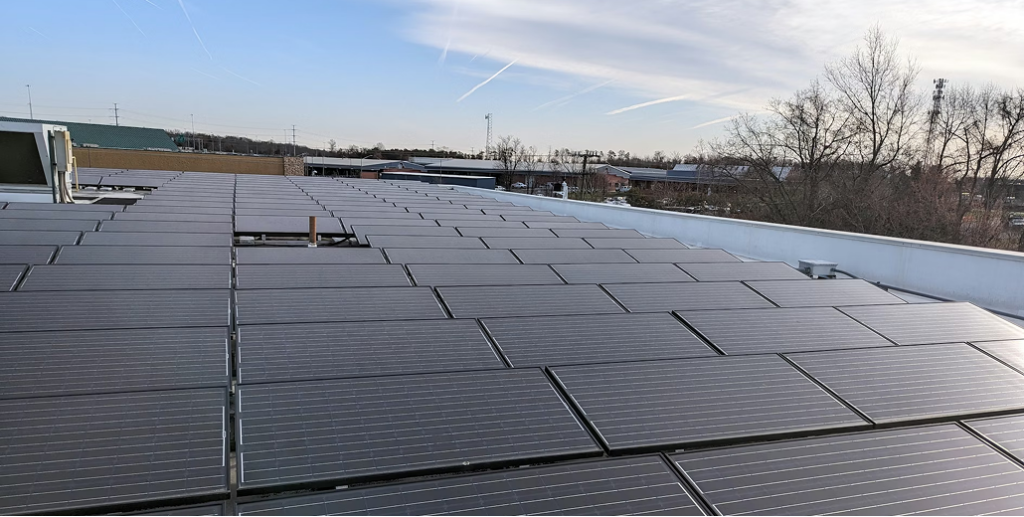
A residential ground mount install typically takes 1–2 weeks end-to-end. Commercial projects run 4–12 weeks depending on scale. For a deeper look at the racking and structural installation specifically, see our guide to ground mount solar racking systems.
What ground mount solar panels cost
Solar panel ground mount pricing varies significantly based on size, foundation type, soil, and wind region. As a rough guide for Australian projects in 2026, residential ground mount systems run around AUD $1.50 to $2.50 per watt installed, while commercial systems at scale can come in below $1.50 per watt. That’s higher than rooftop solar (which sits at around $0.90–$1.30 per watt after STC) because of the structure and foundations, but lower than solar carports.
A worked example: a 6.6 kW residential ground mount system installed for around $14,000 (mid-range) would be reduced to roughly $12,500 after STCs at the 2026 rebate rate of approximately $216 per kW. With a typical Australian electricity rate of 30c/kWh and self-consumption around 50%, that system would pay back in roughly 6–8 years before factoring in the production uplift from optimal tilt and orientation.
For a complete breakdown including foundations, rebates, and worked commercial examples, see our guide to ground mount solar cost for installers. Larger commercial projects have their own pricing dynamics, which we cover in our overview of ground mounted pv system installations for commercial projects.
Build smarter ground mount projects with Nova
At Nova, we’ve spent more than 15 years designing solar mounting systems that make installers’ lives easier and customers’ projects more reliable. The NOVA Ground Mount System is built around our “less is more” philosophy: fewer components, single-bolt rail clamps, integrated earthing pins, and pre-fabricated holes for tilt adjustment from 5° to 60°. It supports both ground screw and concrete ballast foundations, comes in Zinc Aluminium Magnesium coated steel for superior corrosion resistance, and installs up to 30% faster than traditional ground mount systems. It’s backed by a 25-year warranty and supported by a technical team that works with you from soil report to commissioning.
Whether you’re quoting a 5 kW residential ground mount or scoping a megawatt-scale commercial array, speak to the Nova technical team for project-specific support, or explore the NOVA Ground Mount System specifications in detail.
Frequently asked questions (FAQ)
Q: Do ground mounted solar panels qualify for the STC rebate in Australia?
A: Yes. Ground mounted solar panels qualify for STCs under the Small-scale Renewable Energy Scheme on the same basis as rooftop systems, as long as they’re installed by a Solar Accreditation Australia (SAA) accredited installer using CEC-approved components. The rebate value depends on system size, postcode zone, and installation year.
Q: Are ground mounted PV panels more reliable than rooftop systems?
A: They can be, but it depends on engineering and materials. A well-designed ground mount system using ZAM-coated steel or marine-grade aluminium, properly engineered to AS/NZS 1170.2 for the local wind region, will typically outlast a rooftop system because there are no roof penetrations to fail. A poorly designed one in a high-wind zone can fail catastrophically. The engineering matters more than the mounting type.
Q: How much land do I need for solar power ground mounted at home?
A: A 5 kW residential system needs roughly 30–40 square metres of clear, unshaded, north-facing ground. A 10 kW system needs 60–80 square metres. The land also needs to be flat or near-flat, accessible for installation equipment, and not over any underground services.
Q: Can I install ground mount solar panels on sloped land?
A: Yes, within limits. Most fixed-tilt ground mount systems can accommodate slopes up to about 10°. Steeper slopes require either custom engineering or terracing, which adds significant cost. For very steep sites, rooftop solar or a custom-engineered structure is usually better value.
Q: Do ground mount systems need planning permission in Australia?
A: Almost always, yes. Most Australian councils require development approval (DA) for ground mount solar installations, though the threshold and process varies. Some councils have streamlined approvals for residential systems under a certain size; others require full DA with engineering, drainage, and neighbour consultation. Check council requirements before quoting.