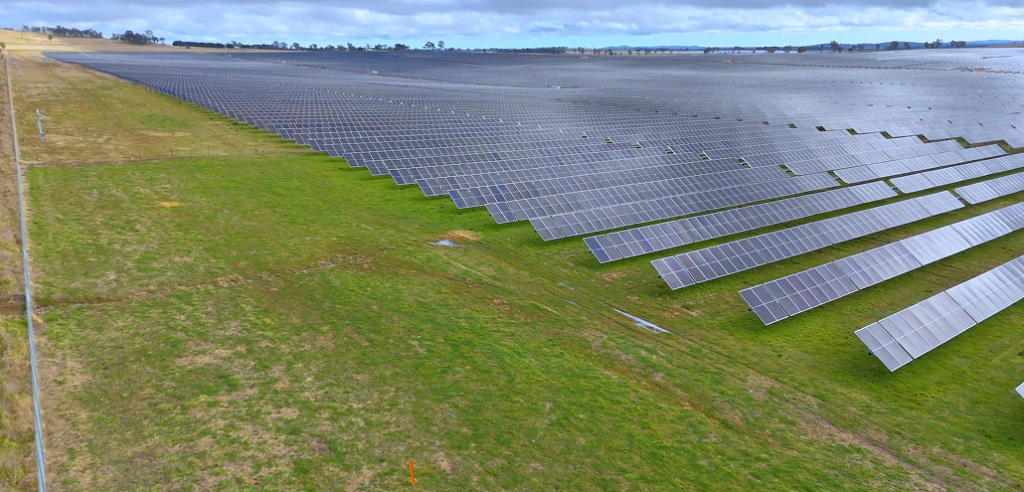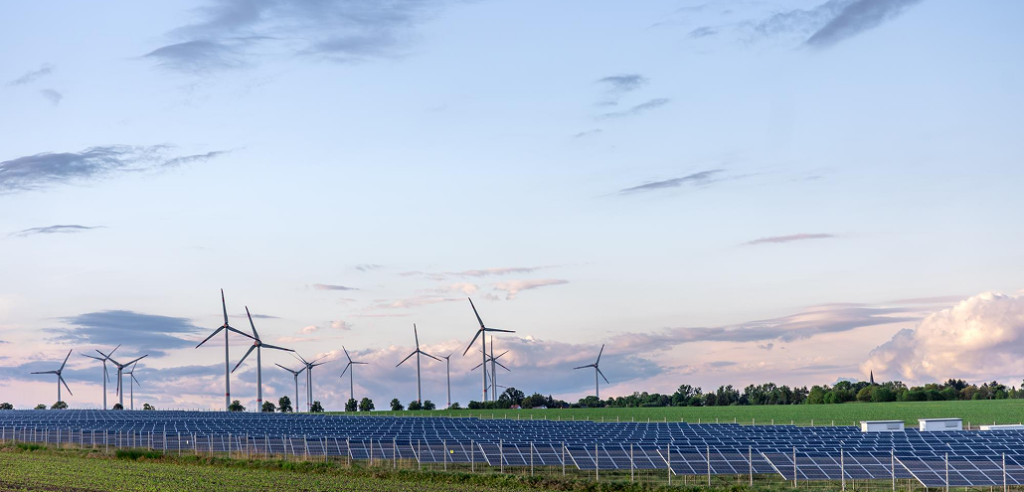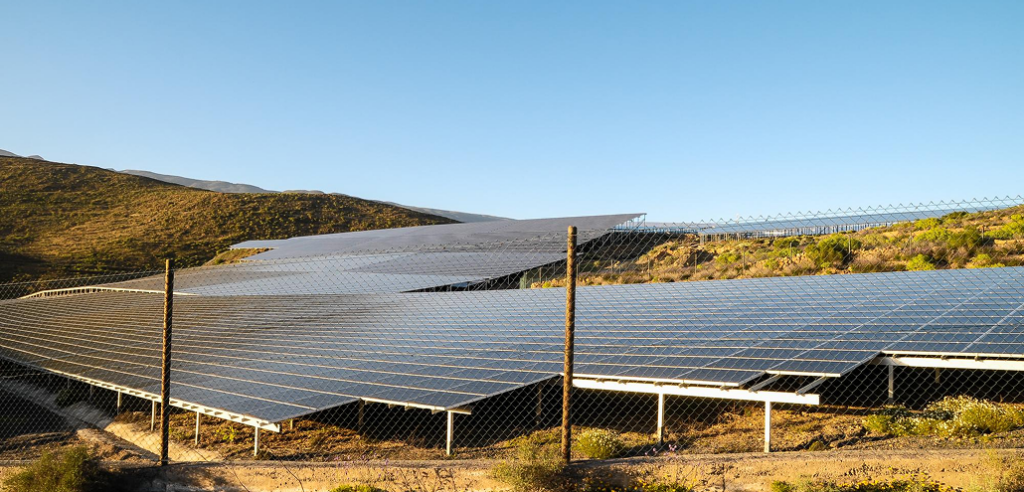
Most commercial properties are sitting on an untapped energy asset—and they park their cars on it every day. Flat, sun-exposed parking lots represent one of the highest-value opportunities for solar deployment available to property owners right now.
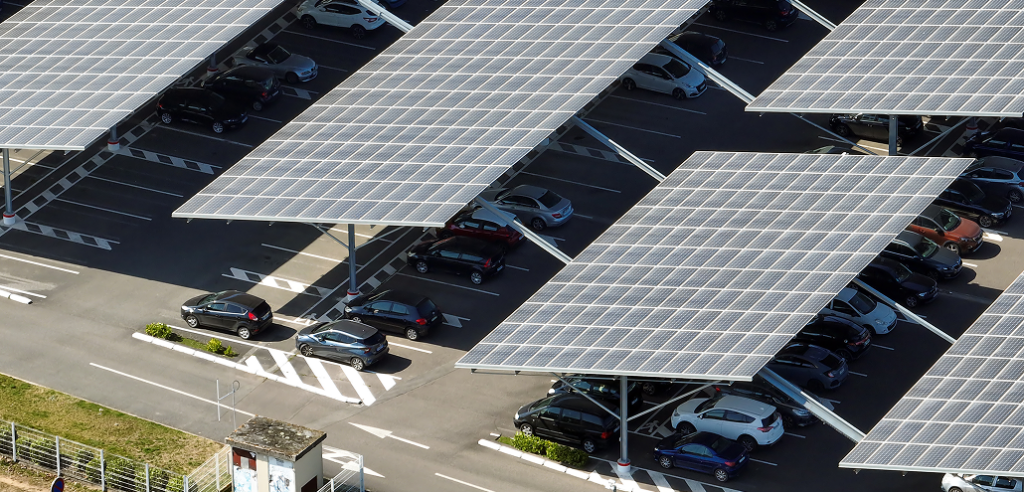
A solar carport system converts that underutilised space into a dual-purpose infrastructure asset: clean energy generation above, protected parking below. With the Australian Government noting that “solar power is now the cheapest source of electricity available,” generating that power directly over your commercial parking area presents a financial case that is hard to ignore.
This article breaks down the real-world use cases for commercial solar carports: where they work, what they deliver, and why more property managers and sustainability leads are treating them as a core infrastructure decision rather than an optional upgrade.
What makes a commercial solar carport different from a residential one?
Scale and intent. A residential solar carport typically covers one or two vehicles and offsets household energy consumption. A commercial solar carport is engineered to cover dozens—or hundreds—of parking spaces, feeding significant amounts of power directly into a building’s grid connection, an EV charging network, or both.
The structural requirements scale accordingly. Commercial installations require purpose-engineered upright supports, heavy-gauge steel or aluminium framing, and wind-load compliance rated for the specific site. These aren’t decorative additions—they’re classified structures, and they need to be built like one.
The ROI logic also shifts. Where a homeowner measures payback in household bill savings, a commercial operator measures it in reduced grid consumption, avoided demand charges, EV infrastructure value, and tenant or customer amenity. The levers are different—and often more powerful.
The core commercial use cases for solar carport structures
1. Offsetting energy consumption at scale
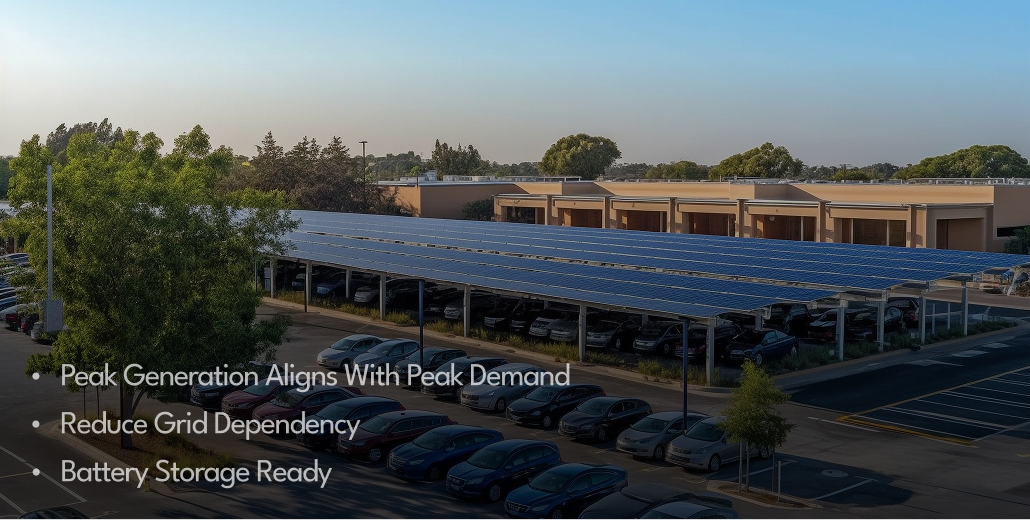
For any business running a large facility—a warehouse, a distribution centre, a retail complex, a hospital campus—energy costs are a significant line item. A well-designed commercial solar carport generates electricity during peak daylight hours, which typically aligns with peak operational demand. That alignment is valuable: you are reducing the amount of grid power you purchase at the most expensive time of the day.
Large commercial sites—particularly those with expansive surface parking—can generate hundreds of kilowatts from a carport array alone. Combined with battery storage, that generation can be shifted to cover evening load peaks, further reducing exposure to time-of-use tariffs.
Depending on the scale of the operation, modelling from independent tools like the SunSPOT solar and battery calculator indicates that an appropriately sized commercial installation can often recover its upfront costs in approximately five years. For high-demand facilities, engineering a system that allows at least 80% of generation to be self-consumed on-site provides an incredibly effective shield against volatile retail electricity prices.
2. EV charging integration
This is the use case that has moved commercial solar carports from a “nice to have” to a strategic necessity for many operators. Fleet electrification is accelerating. Staff and customer EV adoption is rising. The question is no longer whether your site needs EV charging infrastructure—it is how you are going to power it without blowing out your energy bill.
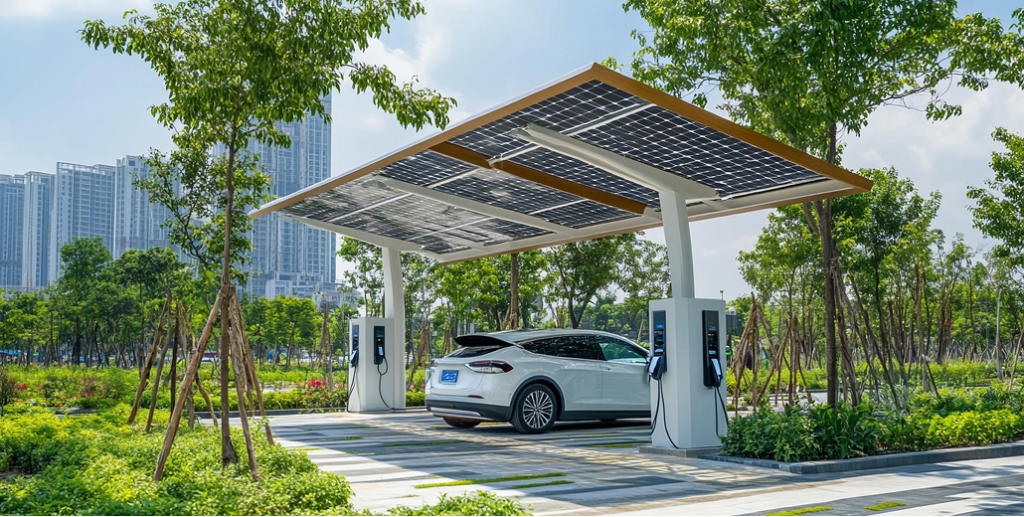
A solar carport structure with integrated EV charging solves that problem at the source. The panels generate power; that power goes directly into chargers embedded in the support columns or mounted nearby. The vehicles recharge from solar energy, not grid electricity. For a business running a commercial fleet, that represents a material reduction in fuel and energy costs across the entire vehicle pool.
The physical design of a carport structure makes EV integration cleaner than rooftop solar ever could. The wiring runs down the uprights directly to the charging points. There is no need to route conduit across a roof and down the building facade.
3. Covered parking as a customer and tenant amenity
Shaded parking is genuinely valued by the people who use it. In hot climates, a covered car park is not a luxury—it is a practical benefit that influences where people choose to shop, work, and do business. Retail centres, office parks, universities, and hospitals that install commercial solar panels for carport structures gain a visible, tangible amenity that differentiates them from competitors with uncovered lots.
For property managers negotiating commercial leases, covered solar parking adds measurable value. Tenants in commercial office buildings increasingly assess sustainability credentials as part of their site selection process. A solar carport ticks multiple boxes simultaneously: it contributes to a building’s green rating, reduces common area energy costs, and improves the parking experience.

4. Maximizing underutilized land without sacrificing function
Rooftop solar has a fixed ceiling. Once the available roof area is covered, that’s it. A parking lot, by contrast, can host a carport array that floats above the existing infrastructure without consuming any additional land or disrupting the parking function below. You keep the car spaces; you gain an energy plant.
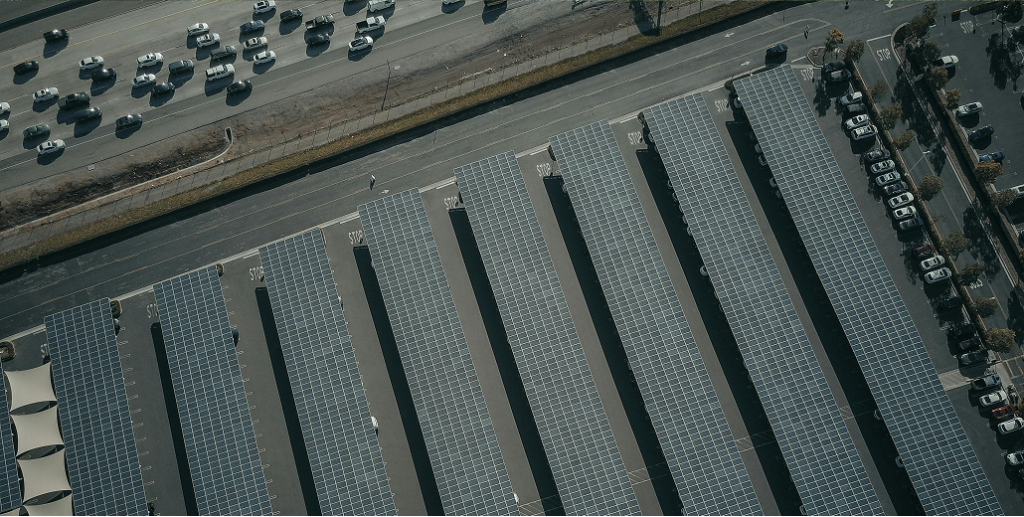
For commercial operators with heritage-listed buildings, unsuitable roof structures, or rooftop plant and equipment that limits available panel area, the carport option can deliver more installed capacity than the roof ever could. A single row of commercial solar carport systems over a standard parking bay can generate roughly 5–7 kW per bay, depending on panel configuration and orientation. Multiply that across a 100-bay carpark, and you are looking at a 500–700 kW installation.
5. Supporting corporate sustainability and emissions targets
Boards, investors, and regulators are paying more attention to Scope 2 emissions than ever before. Scope 2 covers purchased electricity—the kind that a commercial solar carport directly displaces. For sustainability managers working toward net-zero targets or green building certifications, on-site solar generation is one of the most direct interventions available.
A commercial solar carport makes the sustainability commitment visible. It is not buried in a utility contract or offset portfolio—it is a physical structure that staff, visitors, and stakeholders can see every day. For organisations where ESG communication matters, that visibility has real value beyond the kilowatt-hours.

What to assess before committing to a commercial installation
Not every site is created equal. Before progressing to design and procurement, commercial operators should evaluate:
- Grid connection capacity: Can your existing grid connection absorb the additional generation, or will you need an upgrade? This is a critical cost variable that is sometimes overlooked in early ROI modelling.
- Structural ground conditions: Soil conditions determine footing type. Bored piers or screw piles are typical for commercial installations, but site-specific engineering is required.
- Local permits and zoning: Commercial solar carports typically exceed the dimensions that qualify for exempt development. A building permit and certified structural drawings are standard requirements.
- Orientation and shading: North-facing panels (in the southern hemisphere) or south-facing (in the northern hemisphere) deliver the highest yield. Nearby structures, trees, or buildings that cast shadows will reduce generation—factor this into your feasibility modelling.
The structure itself is the investment that protects everything above and below it. Specifying a system with verified wind-load compliance, hot-dip galvanised steel or premium aluminium framing, and an integrated water management system is not a premium upgrade—it is the baseline for a structure that will still be performing in 25 years.
What did we learn?
A commercial solar carport is not a single-purpose asset. It generates electricity, provides EV charging infrastructure, creates covered parking amenity, and delivers measurable progress against sustainability targets—all from space that was previously doing nothing more than holding parked cars.
The ROI case is strongest at scale, which is exactly where commercial operators have the advantage over residential. A well-specified solar carport system designed with the right structural integrity, correct wind-load engineering, and integrated water protection will generate returns for decades—long after the upfront capital has been recovered.
For property managers and sustainability leads evaluating their options: the parking lot is not a cost centre waiting to be managed. It is an energy asset waiting to be built.Ready to unlock the energy potential of your commercial site? Contact the NOVA Mounting team today to discuss structural feasibility and premium solar carport solutions for your next project.